
How to Verify a Historical Fact in Five Minutes: A Beginner's Guide
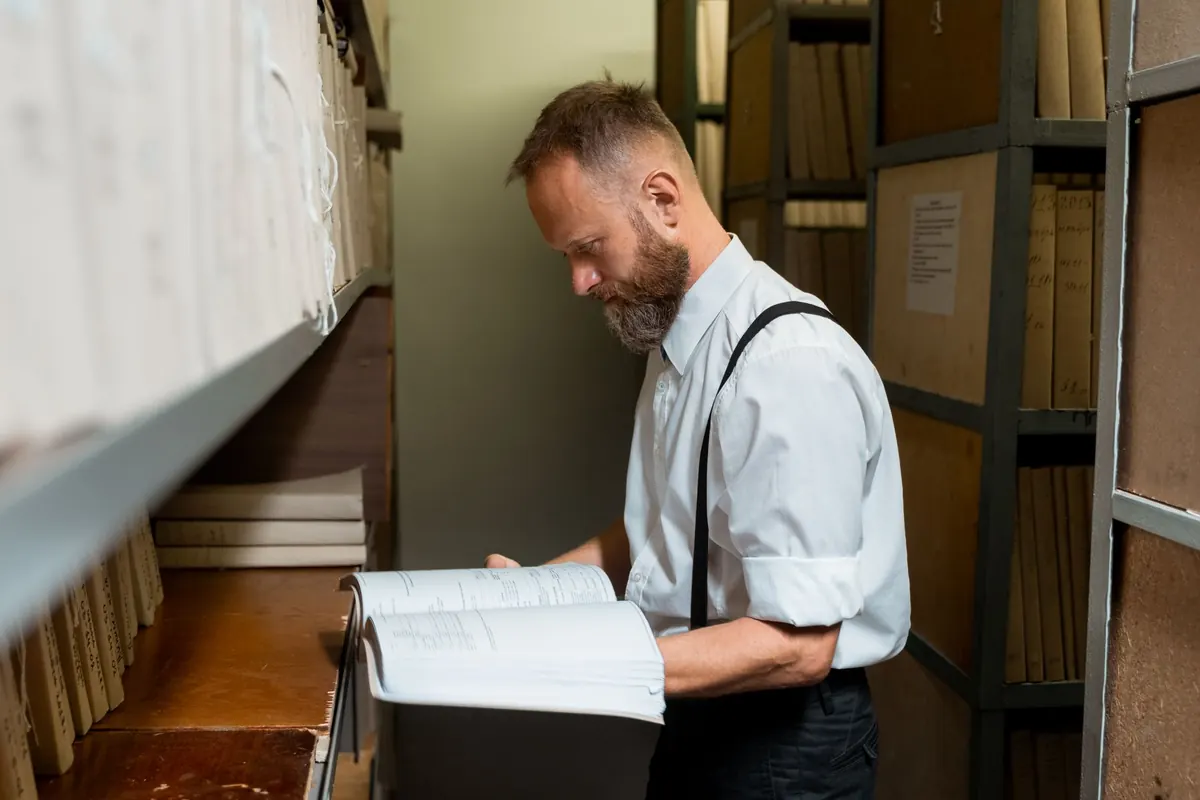
A friend sends you a screenshot: a photograph of a plaque, a quotation attributed to a wartime prime minister, a date that sits slightly wrong in your head. You have a nagging feeling something is off, but you can't say what, and the reply box is waiting. Five minutes of checking will usually tell you whether a claim is solid, shaky or invented — and it's a skill anyone can pick up.
What follows is not a lecture on historiography. It's a working method, the kind of thing you can do on a phone while the kettle boils.
Break the claim into checkable parts
Historical claims usually arrive as bundles. Take this one: Mary Shelley wrote Frankenstein in Switzerland during the wet summer of 1816, when she was eighteen. That single sentence contains four separate assertions — a person, a place, a date and a circumstance — and they don't all carry equal weight. Shelley began the novel in 1816 and it was published in 1818; she was eighteen when she started it and twenty when it appeared. A claim that gets the date of publication wrong may still be broadly right about the summer.
So your first move is to rewrite the claim as a short list: who, what, when, where, and how we supposedly know. Then ask which single part, if false, would collapse the whole thing. That's the part worth spending your time on.
Separate facts from judgements while you're at it. "Britain spent more on its navy than on its army in the 1890s" is checkable. "Britain's worst prime minister was..." is a matter of taste dressed up as a fact, and no amount of source-hunting will settle it.
Test the date against two timelines
Dates are the easiest thing to falsify, because they have to fit with everything else. A claim that a machine was patented before the technology it depends on existed is wrong regardless of how confident the caption sounds. So anchor the date to two things you already know from the same decade and see whether it sits comfortably between them.
Two quirks of the calendar trip up honest people as well as dishonest ones. Britain did not adopt the Gregorian calendar until 1752, when eleven days were skipped; and until the same year, the English legal year began on 25 March, which is why some documents are dated in two ways, such as "1730/31". A document apparently dated February 1730 may actually follow one dated December 1730 in modern reckoning. When a date looks impossible, check whether it's a calendar problem rather than a lie.
Follow the trail back to the source
Screenshots strip provenance, and provenance is most of the story. Search the distinctive phrase — in quotation marks, which tells the search engine to keep it intact — and see how far back the versions go. If every copy traces to one unsourced blog post, that's useful information. If you can get to a newspaper archive, a museum catalogue entry or a scanned book, better still.
Wikipedia is a perfectly good map, not a destination. Treat it as a list of footnotes and go and read the footnotes. And remember that age is not the same as authority: a nineteenth-century county history may simply be repeating a local legend that had been retold for two hundred years. A source written close to the event can still be wrong, biased or exaggerated. Corroboration beats antiquity.
Red flags that keep appearing
- A quotation with no date, no occasion and no publication. Real quotations almost always leave a paper trail.
- "Historians agree", "everyone knows" or "it's a well-known fact" with no name attached. The best-known version of this is the line about doing the same thing repeatedly and expecting a different result, often attributed to Einstein, though no source has been found in his writings.
- Suspiciously tidy numbers. "Exactly 10,000 men" and "three million died" are the sort of figures that get rounded in the retelling and then quoted as if precise.
- A past that flatters the present — people in the past holding exactly the opinions we would like them to have held.
- Photographs with no caption, archive reference or photographer, especially sharp colourised ones doing the rounds as "rare".
- Great inventions credited to a single hero at a single moment, when the record shows a slow, contested development.
Two tests worth running
The opposite test: if this claim were false, what would the surviving evidence look like? Ask whether what you're looking at was produced for the purpose you're using it for. A portrait is evidence that someone wanted a portrait painted, not necessarily that the sitter looked like that.
The independence test: find a second source, then ask whether it really is a second source. If it cites the same origin as the first, you have one source and two copies of it.
Why the classic myths survive
Vikings did not wear horned helmets in battle; that image comes largely from nineteenth-century opera and costume design. Napoleon was not unusually short by the standards of his time and country — the confusion partly comes from French and British units being different lengths, plus a good deal of British propaganda. Marie Antoinette almost certainly never said "let them eat cake"; a similar line appears in Rousseau's Confessions, written when she was a child.
These stories survive because they are memorable, they fit a neat moral, and repetition beats correction. If you want to check one, stop looking for evidence that it happened and start looking for the earliest appearance of the story. You will usually find a play, a poem, a cartoon or a joke.
When five minutes isn't enough
Five minutes gets you to "probably fine" or "probably not", which is enough for a group chat and nowhere near enough for an essay, a family history write-up or a dispute about a listed building. If a claim matters — legally, academically or financially — go to an archivist at a local record office, a university library or a specialist society. That is a proper use of an expert, and they are usually pleased to be asked.
The five-minute routine
- Write the claim as one sentence with the checkable parts separated out.
- Search the distinctive phrase and find the earliest version of it.
- Read the source behind the claim and check that it actually says what it's said to say.
- Test the date against two facts you know from the same period, and check for calendar quirks.
- Look for one genuinely independent second source.
- Record what you found, and what you couldn't. "No contemporary record of this" is a finding, not a failure.
Then share it the way a careful person would: with the uncertainty left in. A date range rather than a precise day, a "reportedly", a nod to where it came from, and a note of what you couldn't confirm. That's how accurate history travels — not by being repeated loudly, but by being passed on honestly.
Photo: MART PRODUCTION / Pexels