
Smartphone vs Digital Camera: Which Takes Better Night Sky Photos in the UK?
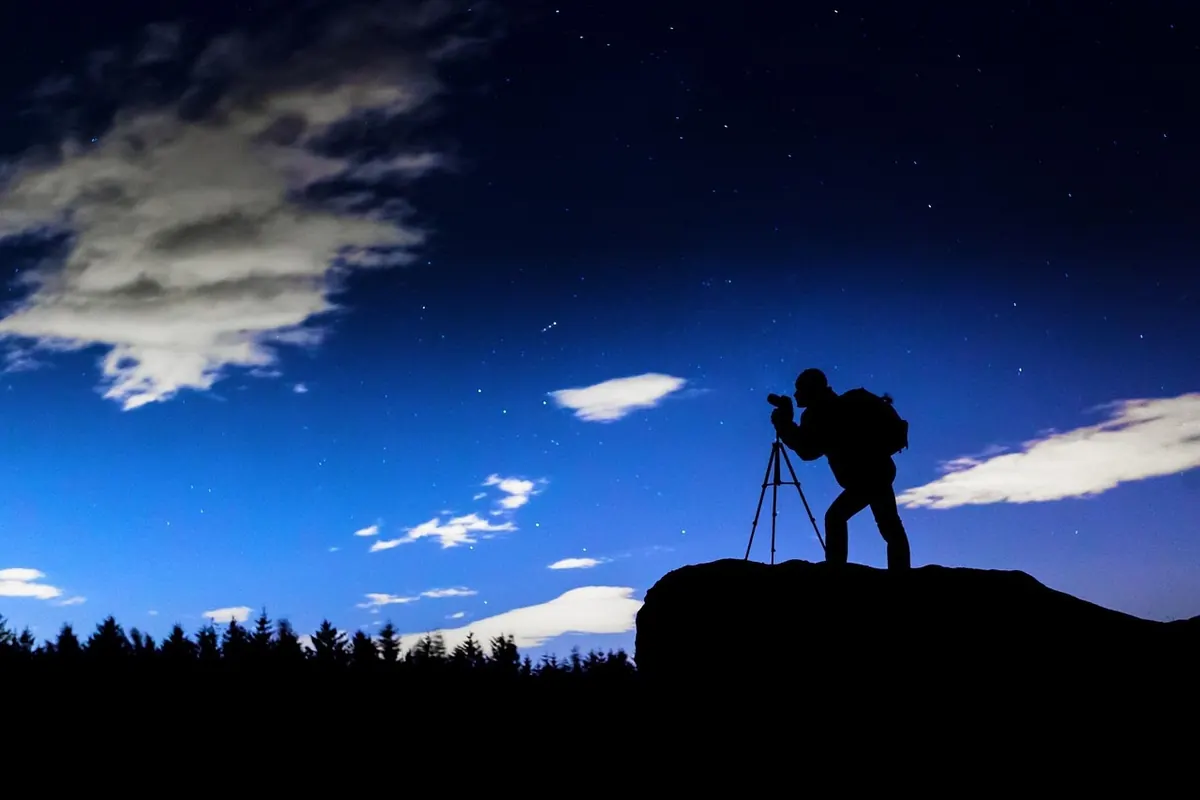
A clear, moonless night in Britain is a rare and precious thing. Between cloud rolling in off the Atlantic, the orange wash of street lighting, and a midsummer in the far north that never gets truly dark, stargazers here learn to take their chances. When a good night finally arrives, the question is simple: do you reach for your phone, or for the camera bag?
What Actually Limits a Night Sky Photo
Every night sky photograph comes down to two things: how much light reaches the sensor, and how much noise the sensor adds while it waits.
The first hurdle is the sky itself. Most of us live under light-polluted conditions where only the Moon, the brighter planets and a few dozen stars cut through. The Bortle scale is a handy way to describe this, running from class 1, a genuinely dark sky, to class 9, the middle of a big city. Many towns and suburbs sit somewhere in the middle of that range. No camera can undo a bad sky, but a decent one can pull detail out of a mediocre one.
The second hurdle is sensor size. The main sensor in a phone is roughly the size of a grain of rice; the sensor in even an entry-level mirrorless or DSLR is many times larger. Bigger pixels collect more photons, which means less noise and better colour. That physical gap has not gone away — but phones have spent the past decade finding clever ways around it.
Where Phones Have the Edge
Stand outside with a modern phone, prop it against a wall, switch on the night mode and wait. On many handsets the software will take a burst of exposures over two to five minutes and stack them into a single image. Google's Pixel phones call it astrophotography mode; Apple, Samsung and others offer their own versions. Each individual frame is grainy rubbish. Averaged together, the noise cancels out and the stars appear.
What that gets you:
- A recognisable Milky Way, constellations and star colour with no extra equipment.
- Stacking, alignment and noise reduction handled automatically.
- A finished photo you can send to a friend within seconds.
- No learning curve beyond finding the mode and holding still.
The limits show up when you zoom in. Stars are soft, faint nebulae are missing, and the field of view is fixed. Cold nights also drain phone batteries quickly, so charge fully before you go and keep the handset in an inside pocket until the last minute.
Where a Dedicated Camera Pulls Ahead
A camera gives you three things a phone cannot fake: control, aperture and time.
Control means manual focus, RAW files and proper exposure settings. Aperture means a fast wide lens — a 14mm f/2.8 or a 20mm f/1.8 lets in a great deal of light across a wide field. Time means you can leave the shutter open for 20 seconds, or several minutes with a tracking mount, and pull in objects a phone will never see: the Orion Nebula, the Andromeda Galaxy, the faint dust lanes of the Milky Way.
The trade-offs are real. You need a sturdy tripod, a remote release or a self-timer, and patience. You will spend more time editing than shooting. The first few attempts will probably be disappointing, and that is normal.
The British Weather and Light Pollution Problem
The UK is an awkward place to photograph the night sky, and it is worth understanding why before you blame your equipment.
We sit between roughly 50 and 60 degrees north. In June, astronomical twilight never properly ends across northern England and Scotland — Orkney and Shetland get the "simmer dim", where the sky glows all night. The practical season for deep-sky work runs from late August through to April, with the best of it in autumn and early spring. The galactic core of the Milky Way is highest on summer nights, exactly when we have the least darkness, so British photographers chase it before dawn in spring and after dusk in autumn.
Cloud is the other constant. A forecast that looks promising at teatime can be useless by ten. Learn the difference between a clear night and a transparent one: haze and thin high cloud wash out faint stars even when the Moon is plainly visible.
Then there is light pollution, and here travelling pays off. Galloway Forest Park, Northumberland, Exmoor, Bannau Brycheiniog, Eryri (Snowdonia) and the South Downs all hold dark sky designations of one kind or another, and even a village twenty minutes from town makes a visible difference. Check a light pollution map before you plan a trip, and go within a few days of a new moon.
Getting a Better Result Tonight
Whatever you own, these steps matter more than the gear:
- Check the moon. A bright moon is the single biggest killer of faint detail.
- Get away from lights. One streetlamp can ruin a wide shot.
- Let your eyes adapt. Give it twenty minutes, and use a red torch rather than a white one.
- Stabilise everything. Tripod if you have one, wall or gatepost if you do not, plus a timer delay so you are not touching the camera when the shutter fires.
- Focus manually. Use magnified live view on a bright star, or focus at infinity and nudge back slightly.
- Start with known settings. On a camera, try ISO 1600 to 3200, f/2.8, and 15 to 20 seconds. The old 500 rule still works as a starting point: divide 500 by your focal length for the longest exposure before stars begin to trail.
- Shoot more frames than you need. Ten or twenty shots can be stacked later to cut noise.
The Honest Answer
For a picture of the sky above a pub, a beach or a back garden — something to share the next morning — a modern phone on a stable surface is genuinely good, and it will beat the camera you left at home because you could not be bothered to carry it.
For anything you want to print, crop or push further, a dedicated camera with a fast wide lens wins comfortably. It gives you the data to work with, and the faint objects that make astrophotography addictive.
The best upgrade is not gear, though. It is a dark sky, a clear night and half an hour of patience. Check the forecast, charge the battery, and take the chance when it comes. In Britain, they do not come often.