
Why Do Starlings Murmurate? The Science of a UK Winter Spectacle
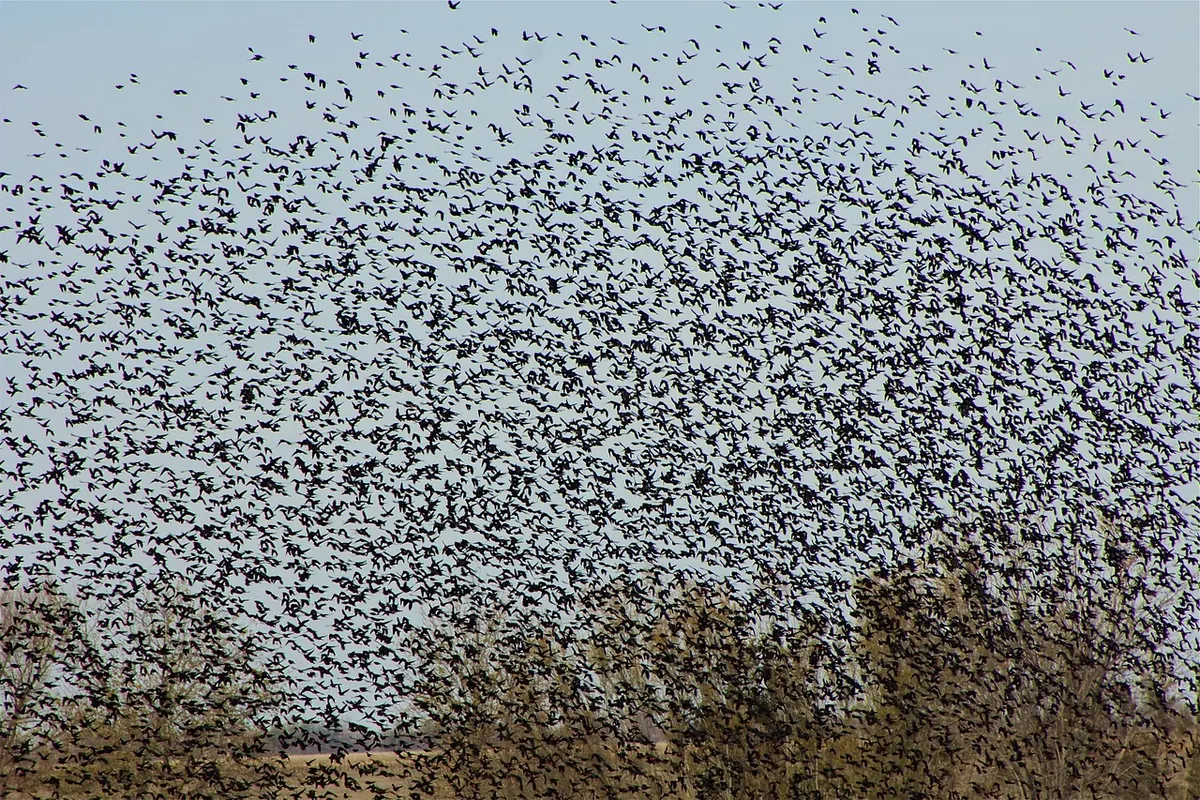
There are winter evenings when the sky over a British town stops behaving like a sky. A scatter of starlings appears above the rooftops, then a few hundred more, and within minutes they have become one shifting mass that folds in on itself, stretches into a ribbon, and finally pours down towards the ground like water finding a drain. Nothing has gone wrong. The birds are doing something starlings have done for a very long time: gathering together before they sleep.
The name is well chosen. It catches the sound as much as the sight — thousands of birds calling and shuffling at once, a low restless whispering that carries across a car park or a seafront. And while a murmuration looks like chaos, it is one of the most orderly things you will see all winter.
What a murmuration actually is
A murmuration is the mass flight display starlings put on before settling into a communal roost. The flying is the overture; the roost is the point. The birds have spent the day feeding in fields, playing fields, parks and gardens, often several miles from where they intend to spend the night, and as the light goes they converge on a shared overnight site.
Those sites are chosen with care. Reedbeds and willow scrub are favourites because they are dense, sheltered and hard for a predator to push through. Conifer plantations work for the same reason. So do piers, town-centre trees, the ledges of warm buildings and the girders of bridges — anywhere that offers cover, a little warmth and a crowd to hide in.
Starlings are sociable all year, but winter takes it further. The birds you watch over a British town in December are not all locals. Resident starlings are joined by visitors from Scandinavia, the Baltic and the Low Countries, which is one reason the flocks in midwinter can be so much larger than anything you see in June.
Three reasons they gather
Nobody hands out invitations. The birds arrive because the benefits of being in a crowd outweigh the costs, and there are three that matter most:
- Safety in numbers. A single starling in open sky is a straightforward meal for a sparrowhawk or a peregrine falcon. A bird inside a dense flock is one target among thousands, and a predator that commits to a dive struggles to lock on to any single bird when the whole mass is twisting around it.
- Warmth. Roosting shoulder to shoulder, sometimes in layers, reduces the heat each bird loses overnight. On a frosty night in a reedbed, that difference matters.
- Information. One long-standing idea is that the roost acts as a noticeboard. A bird that has found a good feeding patch is worth following in the morning, and a bird that has found nothing is worth avoiding. Whether or not that is the main purpose, the habit of gathering in the same place night after night certainly helps starlings find each other.
How thousands of birds turn as one
The obvious question is how a flock of tens of thousands manages to change direction without a leader, a choreographer or a collision. The answer is that no bird is watching the whole flock. Each starling is tracking a small number of its closest neighbours — research on starling flocks has pointed to roughly seven — and adjusting its own position and speed to match theirs.
That is a neat trick, because it means the rule stays the same whether the flock is fifty birds wide or five hundred. Rather than reacting to whatever happens to be within a fixed distance, each bird responds to a fixed number of companions. As the flock spreads out, the links stretch rather than break.
The result is that a turn starting on one side ripples across the whole group almost at once, and the far edge appears to move before the birds there could possibly have seen the cause. No bird is in charge. The shape is what happens when thousands of individuals follow the same simple rule at the same time.
Why the shapes keep changing
Half the pleasure of watching is that no two evenings look alike. Flocks tighten into a ball, then stream out into a long skein, then bunch again. Some of that is simply the flock reorganising as more birds arrive from different directions.
But watch closely and you will often spot the cause of a sudden, sharp ripple: a predator passing underneath. When a sparrowhawk or peregrine cuts through the air below, the birds closest to it turn away first, and the movement spreads outwards as a visible wave. The flock has effectively flinched.
As the light fades, the display winds down. Birds begin dropping into the roost in batches rather than all at once, and the sight of a few thousand starlings funnelling into a reedbed is oddly like watching water disappear into gravel. Within twenty minutes the sky is empty and the noise has settled to a murmur.
When and where to see one
Murmurations build through autumn and peak between November and February, with the largest and most reliable displays usually in December and January. Good weather helps: clear, still evenings give the birds more time in the air, while wind and heavy rain tend to cut things short.
Well-known winter roosts in the UK include Brighton Pier, the seafront at Aberystwyth, Gretna Green in Dumfries and Galloway, the reedbeds of the Somerset Levels around Ham Wall and Shapwick Heath, and RSPB Leighton Moss in Lancashire. Many towns have smaller, less celebrated roosts of their own — a retail park, a supermarket car park, a churchyard — and local wildlife trust and RSPB pages are the quickest way to find one near you.
How to watch without spoiling it
- Arrive about an hour before sunset. The birds start assembling well before the display proper, and the best of it often happens in the last twenty minutes of daylight.
- Choose your spot in advance. A slight rise, a bridge or an open stretch of promenade gives you a clear view without putting you between the birds and the roost.
- Keep your distance from the roost itself. Standing directly underneath it will push birds away, and a disturbed roost means a cold night for them.
- Leave the torch, the drone and the loud music at home. Keep dogs on a lead and voices down. This is the one evening of the year when a bit of quiet really does pay off.
- Dress for standing still. Binoculars are useful for detail, but the spectacle is best taken in with the naked eye.
- Stay to the end. The drop into the roost is the part most people miss, and it is usually the best bit.
Why it is worth braving the cold
Starling numbers in the UK have fallen steeply since the 1970s, and the species is now red-listed as a bird of conservation concern. Big murmurations still happen, but they are no longer something you can take for granted, and a site that draws thousands one winter may draw a few hundred the next.
That is all the more reason to go and stand in a cold car park one January evening and watch. You do not need equipment, a ticket or any expertise. You need a clear evening, an hour of your time and somewhere to lean. Then let several thousand birds show you what happens when everyone follows the same simple rule at once.
Photo: Danjocross / Pixabay